


What if most gym workouts make you stronger in the gym but not for real life?
Functional strength training fixes that by building movement you actually use every day.
This post shows practical full-body routines, the core movement patterns, and simple ways to progress across three skill levels.
You’ll get ready-to-use sessions that train squats, hinges, pushes, pulls, lunges, carries and rotation.
The goal: move easier and with less strain when you climb stairs, carry groceries, or reach overhead.
No isolation exercises, no fluff, just compound work that transfers to daily life.
Practical Full‑Body Functional Routine Built for Real‑World Movement

Functional strength training is all about compound, multi‑joint movements that actually show up in your daily life. You’re not isolating a single muscle in some fixed machine. You’re squatting, hinging, pushing, pulling, lunging, and carrying to train your body like the integrated system it is. The whole point? Getting better at the stuff you already do. Picking up groceries. Climbing stairs. Reaching overhead. Carrying a kid. Twisting to check your blind spot.
Most beginner routines stick to a pretty consistent formula: 3–4 sets of 10–12 controlled reps with 1–2 minutes rest between sets. Before you get into the main work, take 5 minutes for light cardio (walking, rowing, bike) and another 5 for mobility drills (hip circles, arm swings, bodyweight squats). This warm‑up gets your joints and nervous system ready for loaded movement. After that, you move through exercises that challenge multiple joints and muscle groups at once, building strength that actually transfers when you’re lifting a suitcase into an overhead bin or bending down to tie your shoes.
A ready‑to‑use full‑body session might look like this:
Goblet squat or barbell back squat – 3 sets of 10–12 reps (level change and lower body strength)
Romanian deadlift – 3 sets of 10–12 reps (hip hinge pattern, posterior chain)
Push‑up or dumbbell chest press – 3 sets of 10–12 reps (upper body push)
Inverted row or dumbbell bent‑over row – 3 sets of 10–12 reps (upper body pull)
Alternating forward lunge – 3 sets of 10–12 reps per leg (single‑leg stability and locomotion)
Farmer’s walk – 3 sets of 40–60 seconds with heavy weight in each hand (loaded carry, grip, posture, core stability)
This structure gives you a balanced blend of pushing, pulling, squatting, hinging, lunging, and carrying in a single 45‑minute session.
Foundational Patterns That Drive Functional Strength

Every good functional routine is built on a handful of fundamental movement patterns. These patterns show up constantly in real life: you squat to sit and stand, hinge to pick up a box, push to open a heavy door, pull to start a lawnmower, lunge to step onto a curb, and rotate to look behind you. Training these patterns under load teaches your nervous system to coordinate muscles across multiple joints. It improves efficiency and reduces the kind of compensation that leads to strain.
The four key movement pillars organize these patterns into a simple framework. Locomotion includes efficient walking, jogging, running, and single‑leg stabilization during movement. Level change covers any action that moves your body up or down in space: crouching to pick something off the floor, stepping onto a stool, or lowering yourself into a chair. Upper‑extremity function includes all pushing, pulling, reaching, and throwing tasks performed by your arms and shoulders. Rotation describes spinal twisting for activities like turning to grab something behind you, checking a blind spot, or swinging a golf club.
Four Movement Pillars
Locomotion trains your ability to move forward, backward, and laterally with stability and control. In a functional routine, this pillar gets addressed through lunges, step‑ups, and single‑leg deadlifts that challenge balance and coordination on one leg at a time.
Level change focuses on safely moving between standing, crouching, and floor positions. Squat variations, deadlifts, and step‑ups all develop the strength and motor control you need to rise from a chair, lift a toddler, or climb stairs without compensating through your lower back or knees.
Upper‑extremity function covers any task where you use your arms to apply force. Push‑ups, overhead presses, and rows train the shoulder girdle and arms to push, pull, and stabilize loads in multiple planes. This supports activities like lifting a box overhead, pulling open a car door, or pressing up from the floor.
Rotation involves controlled twisting of the torso while keeping your hips and lower body stable. Exercises like standing medicine ball rotations, cable chops, and rotational lunges improve your ability to turn, reach across your body, or throw an object without putting too much strain on your spine.
Beginner Functional Strength Routine Template (3 Days/Week)

A beginner‑friendly functional routine typically uses 2–3 sets of 8–15 reps per exercise, trains the full body in each session, and includes both bilateral movements (two legs or arms working together) and unilateral movements (one limb at a time). The template below gives you three workouts per week with at least one rest day between sessions. Start each workout with 5 minutes of light cardio and 5 minutes of mobility work (hip circles, leg swings, arm circles, bodyweight squats). Focus on controlled tempo. Take 2 seconds to lower, pause briefly, then lift in 1–2 seconds. Rest 1–2 minutes between sets.
Day 1 – Lower and Core Focus
- Goblet squat – 3 sets of 10 reps
- Romanian deadlift (dumbbell or kettlebell) – 3 sets of 10 reps
- Alternating reverse lunge – 3 sets of 8 reps per leg
- Plank with shoulder taps – 3 sets of 20 taps (10 per side)
- Glute bridge – 3 sets of 12 reps
Day 2 – Upper and Core Focus
- Push‑up (or incline push‑up) – 3 sets of 10 reps
- Inverted row (or dumbbell bent‑over row) – 3 sets of 10 reps
- Overhead dumbbell press – 3 sets of 8 reps
- Hollow hold – 3 sets of 30 seconds
- Farmer’s carry – 3 sets of 40 seconds
Day 3 – Full‑Body Circuit
- Alternating step‑up (onto bench or box) – 3 sets of 10 reps per leg
- Kettlebell swing (or dumbbell swing) – 3 sets of 12 reps
- Dumbbell bent‑over row – 3 sets of 10 reps
- Goblet squat – 3 sets of 10 reps
- Plank – 3 sets of 45 seconds
To progress week to week, add one or two reps to each set, increase the weight by the smallest available increment (usually 2.5–5 pounds for dumbbells), or reduce rest intervals by 10–15 seconds once you can complete all sets with good form. After 4–6 weeks, consider adding a fourth set to key exercises or introducing a unilateral movement like single‑leg Romanian deadlifts to challenge balance and address strength imbalances between sides.
Intermediate Program: Functional 4‑Day Split for Strength and Mobility
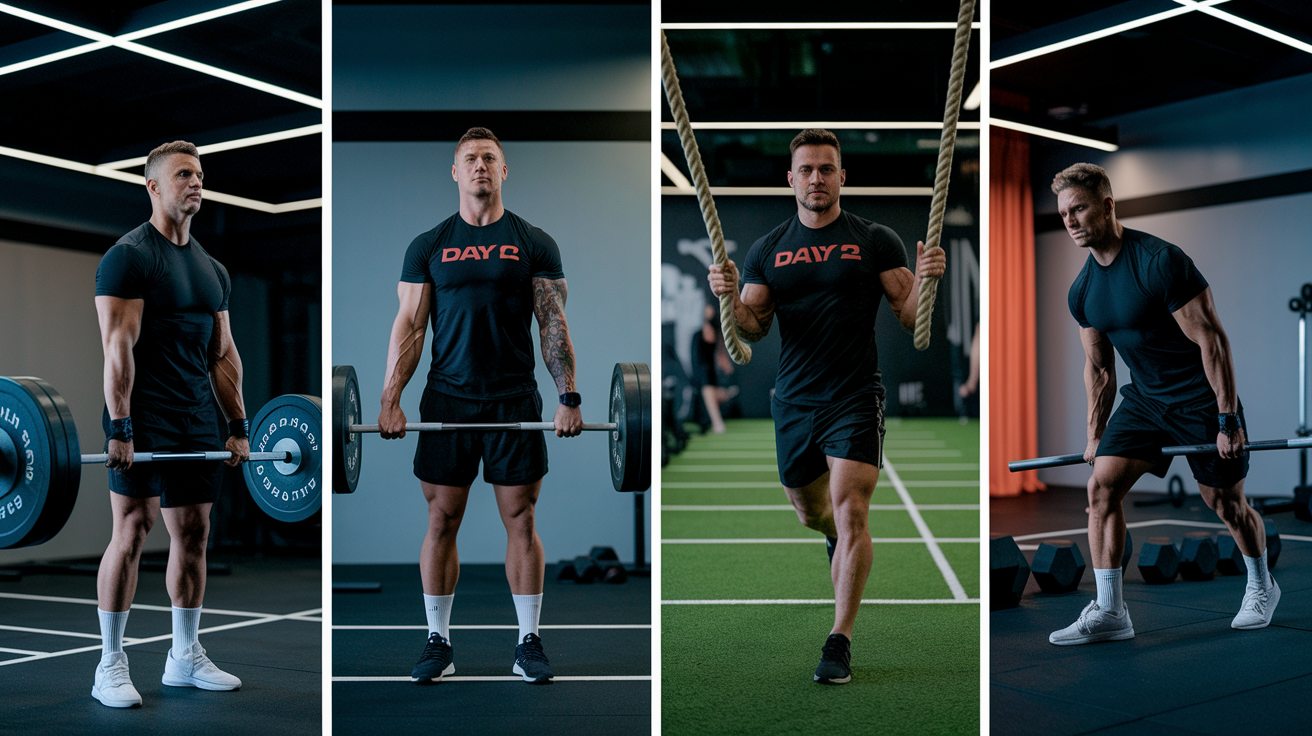
An intermediate functional program typically spreads training across four days per week. This lets you increase load and volume on specific movement patterns while still training full‑body functions. This split mixes heavy lower body work, push‑pull upper body sessions, unilateral exercises like single‑leg deadlifts and step‑ups, and conditioning circuits that elevate heart rate while maintaining movement quality. You’ll continue using 10–12 reps for most strength exercises, but you can drop to 6–8 reps on heavy compound lifts and extend carries or loaded walks to 60–90 seconds for grip and postural endurance.
Day 1 – Lower Body Heavy
Begin with a barbell or trap‑bar deadlift for 4 sets of 6–8 reps, resting 2 minutes between sets. Follow with barbell or dumbbell goblet squats for 3 sets of 10 reps, then single‑leg Romanian deadlifts (holding a dumbbell or kettlebell) for 3 sets of 8 reps per leg. Finish with walking lunges for 3 sets of 20 total steps and a plank variation (side plank or plank with leg lift) for 3 sets of 45 seconds per side. This day builds raw strength in the hinge and squat patterns while adding single‑leg stability work.
Day 2 – Upper Body Push‑Pull
Start with a horizontal push (barbell bench press, dumbbell chest press, or weighted push‑ups) for 4 sets of 8–10 reps. Pair it with a horizontal pull (inverted row or cable row) for 4 sets of 10 reps. Add a vertical push (overhead press with barbell or dumbbells) for 3 sets of 8 reps and a vertical pull (pull‑up or lat pulldown) for 3 sets of 8–10 reps. Close the session with a farmer’s carry for 3 sets of 60 seconds, carrying the heaviest weight you can manage with upright posture. This structure balances pushing and pulling in multiple planes and builds shoulder stability and grip strength.
Day 3 – Conditioning Circuit or Active Recovery
Use a circuit format with moderate weights and minimal rest to improve work capacity and keep your heart rate elevated. A sample circuit: kettlebell swings (15 reps), bodyweight squat thrusts (10 reps), dumbbell alternating step‑ups (10 reps per leg), battle ropes (30 seconds on, 30 seconds off), and plank shoulder taps (20 taps). Complete 4 rounds with 1 minute rest between rounds. This session improves cardiovascular conditioning while reinforcing movement patterns under fatigue. Or use this day for light mobility work, a 20‑minute walk, or a yoga‑style flow if you need extra recovery.
Day 4 – Full‑Body Functional Circuit with Unilateral Work
Combine strength and stability in a single session. Start with trap‑bar or barbell deadlifts for 3 sets of 6 reps. Move to alternating single‑arm overhead presses for 3 sets of 8 reps per arm, then single‑leg step‑ups onto a bench for 3 sets of 10 reps per leg. Add a rotational movement like standing medicine ball slams or cable chops for 3 sets of 10 reps per side, then finish with a loaded carry variation such as a suitcase carry (heavy weight in one hand) for 3 sets of 45 seconds per side. This day ties together hinge, press, lunge, rotation, and carry in one session.
Advanced Functional Circuit With Power, Rotation, and Loaded Carries
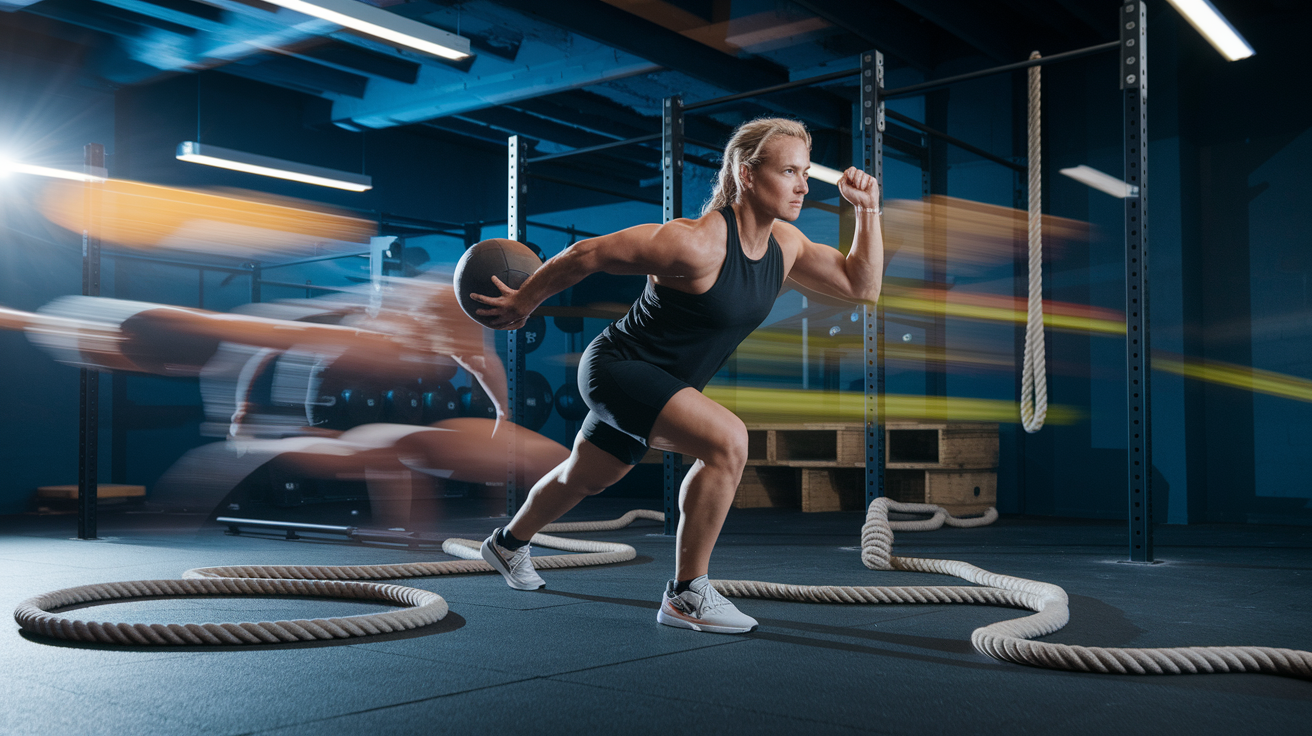
Advanced functional training plans layer in explosive power movements, rotational exercises, and longer or heavier loaded carries to push work capacity and coordination under fatigue. These circuits use shorter rest intervals (30–60 seconds between exercises, 90 seconds between full rounds), heavier implements, and movements that demand quick force production alongside controlled stability. The goal is to maintain technique quality while your heart rate climbs and fatigue accumulates.
A sample advanced circuit might include:
Kettlebell swings – 15 reps (explosive hip extension)
Medicine ball slam – 12 reps (power generation and deceleration through the core)
Battle ropes – 30 seconds on, 30 seconds off (upper body power endurance and grip)
Farmer’s walk with heavy dumbbells or kettlebells – 60 seconds (postural stability, grip, core bracing under load)
Rotational medicine ball throw to wall – 10 reps per side (rotational power and trunk control)
Burpee over bar – 10 reps (full‑body conditioning with a vertical jump component)
Complete 4–6 rounds of this circuit. Rest 90 seconds after each full round. The combination of swings, slams, ropes, and throws trains your ability to produce and absorb force quickly, which translates to activities like lifting a heavy bag into a car trunk, sprinting up stairs, or playing recreational sports without injury.
To progress intensity, increase the weight of the carries, reduce rest between exercises to 20–30 seconds, add an extra round, or introduce more complex movements like sandbag cleans, single‑arm overhead carries, or plyometric step‑ups. Always prioritize form. If technique breaks down, reduce load or extend rest rather than pushing through sloppy reps that increase injury risk and reduce transfer to real‑world tasks.
Minimal‑Equipment and No‑Equipment Functional Workouts for Home

Bodyweight functional workouts remove the barrier of equipment while still training the same movement patterns you use every day. A typical home‑based session uses your body weight as resistance and incorporates household objects like a backpack filled with books, a gallon water jug, or a sturdy chair for added load or support. These routines are ideal for travel, busy schedules, or when you’re building initial strength before moving to loaded exercises.
A no‑equipment functional circuit might look like this:
Squat into alternating side crunch – 3 rounds of 15 reps (combines lower body and rotational core work)
Reverse lunge with lateral raise holding a household object – 3 rounds of 15 reps per leg (single‑leg stability plus shoulder endurance)
Plank with shoulder touch – 3 rounds of 20 taps (anti‑rotation core stability)
Bodyweight squat into overhead press with household object – 3 rounds of 15 reps (full‑body coordination)
Negative push‑up – 3 rounds of 10 reps (slowly lower for 3–5 seconds, then drop knees to press back up if needed)
Leg raises – 3 rounds of 12 reps (lower abdominal and hip flexor control)
Warm up with 1 minute each of bodyweight squats, butt kicks, high knees, and a plank hold. Rest 1 minute between rounds. The entire session takes 25–30 minutes and requires no equipment beyond a stable surface and a household object for added resistance.
To adjust difficulty, slow down the tempo (a 4‑second lower on squats or push‑ups significantly increases challenge), add a pause at the bottom or top of each rep, increase reps to 20 per round, or add a fourth round. For an easier version, reduce reps to 10, take 90 seconds rest between rounds, or perform exercises on an incline (hands on a chair for push‑ups) to decrease load.
Warm‑Up Protocols and Mobility Drills for Functional Sessions
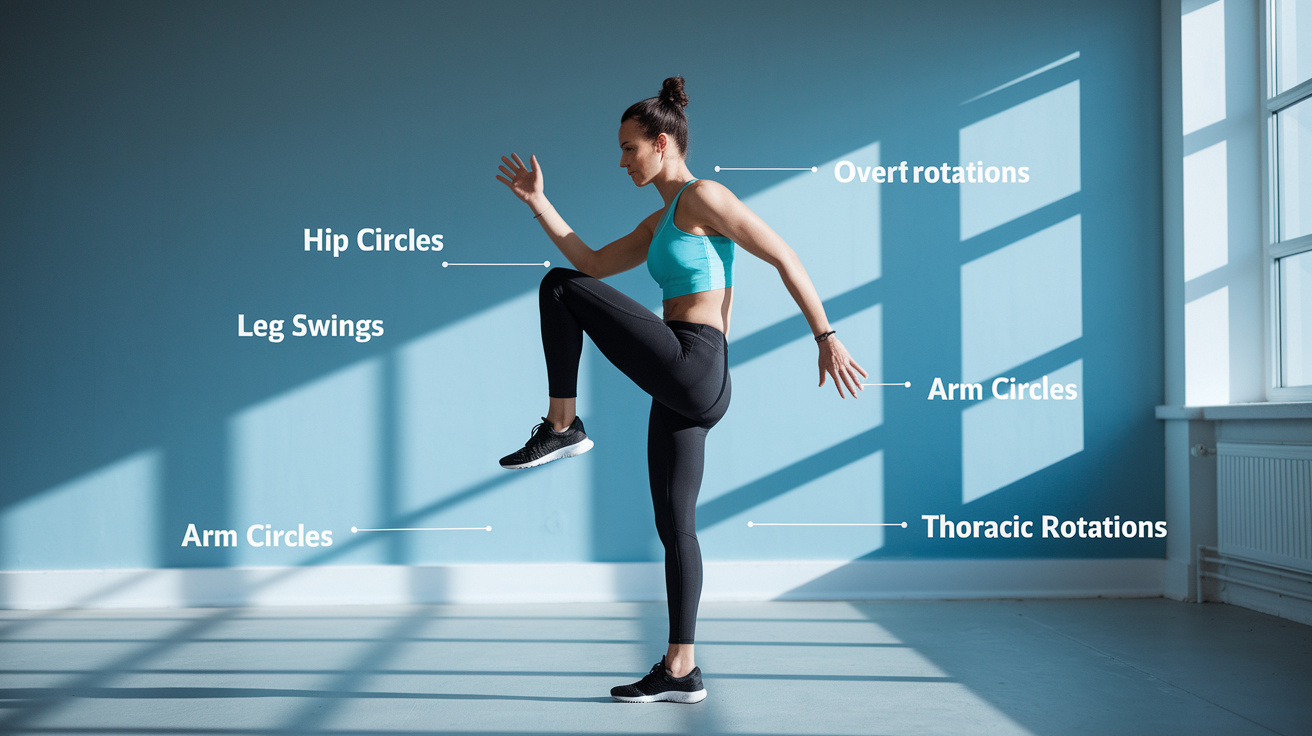
A consistent warm‑up prepares your joints, nervous system, and cardiovascular system for the demands of loaded movement. Functional strength sessions benefit from 5 minutes of light cardio (walking, rowing, biking, or jumping jacks) to raise core temperature and heart rate, followed by 5 minutes of dynamic mobility work that moves your hips, shoulders, and spine through the ranges you’ll need in the workout. This structure appears across beginner, intermediate, and advanced routines because it reduces injury risk and improves movement quality from the first working set.
Dynamic mobility drills should match the movement patterns in your session. If your workout includes squats and lunges, spend time on hip circles, leg swings, and bodyweight squats. If you’re pressing and rowing, include arm circles, shoulder pass‑throughs with a band or broomstick, and thoracic rotations. The goal is to move joints actively through their available range, not to stretch passively or hold positions for long durations before lifting.
A simple 5‑minute mobility sequence might include:
Hip circles – 10 per direction, each leg
Leg swings – 10 forward‑back and 10 side‑to‑side per leg
Arm circles – 10 forward, 10 backward
Bodyweight squat with pause – 8 reps, holding the bottom for 2 seconds
Thoracic rotation in quadruped position – 8 reps per side (on hands and knees, rotate one arm toward the ceiling)
After your working sets, cool down with 5 minutes of easy walking or slow cycling, then spend 5–10 minutes on static stretching or foam rolling for muscles that feel tight. This cool‑down helps bring heart rate down gradually and supports recovery between sessions.
Core Stability and Anti‑Rotation Protocols

Deep‑core training focuses on the muscles beneath the surface: the transverse abdominis, pelvic floor, diaphragm, and spinal stabilizers that brace your trunk and prevent unwanted movement during lifts, carries, and rotational tasks. Unlike traditional ab exercises that emphasize flexion (like crunches), anti‑rotation and anti‑extension drills teach your core to resist motion. And that’s how your core actually functions in real life when you carry a heavy bag on one side or push a stroller uphill.
Beginners should include deep‑core work 2–3 times per week, either as a standalone 10‑minute session or integrated into the end of a strength workout. Advanced trainees can add core stability exercises daily or at the start of every session as part of the warm‑up. The key is consistent, controlled execution. Rushing through reps or allowing your lower back to arch defeats the purpose and increases injury risk.
Plank variations are a cornerstone of anti‑extension training. A standard plank trains your ability to hold a neutral spine under gravity. To progress, add shoulder taps (20 alternating taps per set, keeping your hips level), leg lifts (one leg at a time, holding for 2 seconds), or side planks with a hip dip (lower and lift your hip for 10 reps per side). These variations force your core to resist rotation and lateral flexion while maintaining tension.
Deep‑Core Exercise Breakdown
Mountain climbers train dynamic core stability while your body moves. Start in a plank position and alternate driving your knees toward your chest for 30 seconds, keeping your hips low and spine neutral. This movement combines anti‑extension with coordination and cardiovascular demand.
Russian twists add rotational control. Sit on the floor with knees bent and feet lifted, holding a light weight or medicine ball. Rotate your torso to tap the weight beside your hip on each side, keeping your lower back stable. Perform 3 sets of 20 total taps.
Bicycle crunches train obliques and hip flexors together. Lie on your back, lift your shoulder blades off the floor, and alternate bringing opposite elbow to knee in a controlled pedaling motion. Focus on exhaling as you rotate, 3 sets of 20 reps.
Frankenstein walks (also called straight‑leg walks) challenge hip flexor and lower abdominal control. Walk forward while kicking one leg straight out in front of you to hip height, alternating legs with each step. Keep your torso upright and avoid leaning back. Perform 3 sets of 20 total steps.
Leg raises target the lower abdominals and hip flexors. Lie flat on your back, press your lower back into the floor, and lift both legs to 90 degrees, then lower them slowly without letting your back arch. If your back lifts off the floor, stop the descent earlier or bend your knees slightly. Perform 3 sets of 10–12 reps.
Dead bug trains anti‑extension in a supine position. Lie on your back with arms extended toward the ceiling and knees bent at 90 degrees. Lower one arm overhead while straightening the opposite leg, keeping your lower back pressed to the floor. Alternate sides for 3 sets of 20 total reps.
Program Design: Sets, Reps, Load, Tempo, and Progressive Overload

Effective functional strength routines balance volume (sets and reps), intensity (load), and tempo (speed of movement) to produce consistent strength gains without excessive fatigue or injury. Most functional programs use 3–4 sets of 10–12 reps for compound exercises, with 1–2 minutes of rest between sets. This range builds a blend of strength and muscular endurance that supports repeated daily tasks. For heavy lifts like deadlifts or squats where your goal is maximal strength, you can drop to 6–8 reps and extend rest to 2–3 minutes. For conditioning circuits or carries, you might use time‑based targets (30–60 seconds) instead of counting reps.
Tempo refers to how quickly you move through each phase of a lift. A controlled tempo (typically 2 seconds to lower, a brief pause, then 1–2 seconds to lift) keeps tension on the working muscles and reinforces good form. Faster tempos (explosive concentric lifts) are useful for power development in advanced trainees, but beginners should prioritize smooth, deliberate movement. Time under tension matters: if you rush through a set of 12 squats in 20 seconds, you’re relying on momentum rather than muscular control.
| Training Variable | How to Progress It |
|---|---|
| Load (weight lifted) | Increase weight by 2.5–5 pounds once you complete all prescribed sets and reps with good form for two consecutive sessions. |
| Volume (sets × reps) | Add one extra set to key exercises, or increase reps by 1–2 per set each week until you reach the top of the range (e.g., 10 → 12 reps). |
| Rest intervals | Reduce rest by 10–15 seconds once you can complete all sets without form breakdown, increasing work density and conditioning. |
| Movement complexity | Progress from bilateral (two legs) to unilateral (single leg), from stable surfaces to unstable, or from assisted to unassisted (e.g., incline push-up to floor push-up). |
Progressive overload is the principle that drives long‑term strength gains. Your body adapts to the demands you place on it, so you must gradually increase one or more variables over time. This doesn’t mean adding weight to every exercise in every session. Small, consistent changes across weeks and months produce better results than large jumps that compromise form or lead to injury. Track your weights, reps, and perceived effort in a notebook or app so you can see patterns and make informed adjustments.
Scaling and Adjustments for Age, Injuries, and Different Ability Levels
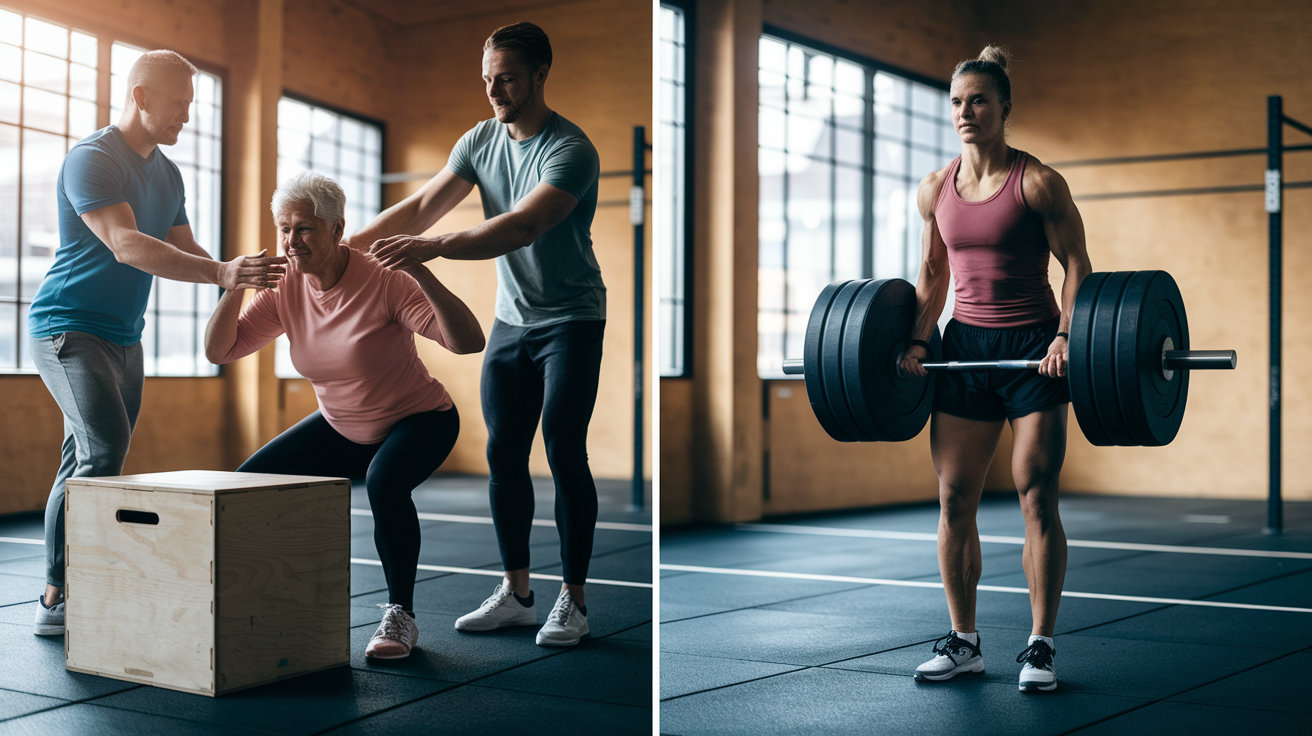
Functional strength training benefits everyone, but programming must match your current ability, injury history, and daily demands. An athlete training for performance will use heavier loads, shorter rest, and more complex movements than an older adult focused on fall prevention and independent living. Both are training functional movement, but the intensity, volume, and exercise selection differ significantly.
If you’re managing an injury or limitation, start with movement regressions that reduce load or range of motion. For example, if a full‑depth squat causes knee pain, try a box squat where you sit back onto a bench at parallel depth, then stand. If overhead pressing aggravates your shoulder, substitute a landmine press or floor press that keeps the arm in a more comfortable angle. For lower back sensitivity, replace barbell deadlifts with a trap‑bar deadlift or a single‑leg Romanian deadlift using a light dumbbell. Always consult a physical therapist or healthcare provider if pain persists or worsens during training.
Common modifications to safely scale functional routines include:
Reduce range of motion. Partial squats, box step‑ups to a lower height, or push‑ups on an incline reduce joint stress while still training the movement pattern.
Slow the tempo. A 4‑second eccentric (lowering) phase increases time under tension and control, making lighter weights more challenging and safer for joints.
Use bilateral support before progressing to unilateral. Master two‑leg squats and deadlifts before adding single‑leg variations that demand more balance and stability.
Substitute household objects or lighter implements. A gallon water jug (8 pounds) or a backpack with books lets you practice the movement pattern at lower intensity until you’re ready for dumbbells or barbells.
Age‑related programming adjustments often involve longer warm‑ups (10 minutes instead of 5), slightly higher rep ranges (12–15 instead of 8–10) to reduce joint stress, and prioritizing balance and mobility work to maintain independence and reduce fall risk. Younger or more athletic populations can tolerate higher volume, shorter rest, and more complex movements like jumps, throws, and rotational power exercises.
Tracking Metrics and Long‑Term Planning for Functional Strength
Tracking progress in functional training goes beyond counting pounds on a barbell. Because the goal is improved movement quality and daily function, your metrics should reflect real‑world performance: how long you can carry a heavy load without stopping, how many flights of stairs you can climb without fatigue, or how easily you can get up from the floor. Alongside these practical measures, track training variables like load lifted, reps completed, rest intervals, and perceived exertion (on a scale of 1–10) to ensure you’re progressing over weeks and months.
For loaded exercises, record the weight and reps for each set in a simple notebook or app. For time‑based work like farmers carries or planks, note the duration and any changes in form quality. If your farmer’s walk distance increases from 40 seconds to 60 seconds at the same weight, you’ve improved grip strength, postural endurance, and work capacity. If you can complete a plank for 60 seconds with a stable, neutral spine where you previously broke form at 45 seconds, your deep‑core stability has improved. These incremental changes compound over time into significant functional gains.
Long‑term planning involves cycling intensity and volume to avoid plateaus and overtraining. A simple approach is to train hard for 3 weeks, then take a deload week in the fourth week where you reduce weight by 20–30 percent or cut volume by one set per exercise. This pattern allows your body to recover and adapt without losing momentum. Every 8–12 weeks, reassess your goals and adjust your routine. Add new movement variations, increase load targets, or introduce a different training format like circuits or higher‑rep endurance work. Mobility and control should improve alongside strength; if your squat depth increases or your shoulder range of motion expands, you’re building functional capacity that reduces injury risk and supports long‑term health.
Sample 4‑Week Functional Strength Progression Plan
A structured 4‑week progression plan gives you a clear roadmap for building functional strength while managing fatigue and recovery. Each week introduces a small increase in load, volume, or movement complexity, allowing your body to adapt gradually without overwhelming your joints or nervous system. The plan below assumes you’re training 3–4 days per week and have mastered basic movement patterns with good form.
| Week | Focus | Load/Volume Goal | Key Movements |
|---|---|---|---|
| Week 1 | Foundation and form | 3 sets × 10 reps at moderate weight; 90 seconds rest | Goblet squat, Romanian deadlift, push-up, inverted row, farmer’s carry (40 seconds), plank (45 seconds) |
| Week 2 | Volume increase | 3 sets × 12 reps at same weight; 75 seconds rest | Same exercises; add alternating reverse lunge (3 sets × 10 per leg) |
| Week 3 | Load increase | 4 sets × 10 reps at 5–10% heavier weight; 90 seconds rest | Same exercises; increase farmer’s carry to 50 seconds, plank to 60 seconds |
| Week 4 | Deload and consolidation | 3 sets × 10 reps at Week 1 weight; 90 seconds rest | Same exercises; focus on perfect form and full range of motion; optional light mobility work |
After completing this 4‑week block, you’re ready to transition into an 8‑week plan that introduces unilateral movements (single‑leg deadlifts, single‑arm presses), more advanced carries (suitcase carry, overhead carry), and higher‑intensity circuits. The 8‑week structure follows the same progression pattern. Add volume in weeks 1–2, increase load in weeks 3–4, deload in week 5, then repeat a similar cycle in weeks 6–8 with slightly heavier starting weights or more complex movement variations. This cyclical approach to progression keeps your training effective, sustainable, and aligned with the long‑term goal of improving how you move every day.
Final Words
Start with compound moves like squats, hinges, presses, rows, and carries to train the patterns you use every day.
This guide gave warm-ups and mobility drills, core anti-rotation work, a 3-day beginner plan, a 4-day intermediate split, an advanced circuit, home options, and a 4-week progression you can follow.
Use the sets, reps, tempo, and scaling tips to progress safely. These functional strength training routines are practical. Build them into a few weekly sessions and you’ll move easier and stay stronger.
FAQ
Q: What are the best exercises for functional strength and what are the 7 functional movements?
A: The best exercises for functional strength are compound moves that match seven core patterns: squat, hinge, lunge, push, pull, carry, and rotation—think deadlifts, squats, step-ups, presses, rows, farmer walks, and twists.
Q: What is the 3-3-3 rule and the 5-3-1 rule in strength training?
A: The 3-3-3 rule uses three exercises for three sets of three reps to practice heavy technique. The 5-3-1 rule progresses load with sets of five, three, then one rep for maximal strength.